I’ve said here many times that Isaac Asimov is my favorite author. It wasn’t until a few years ago that I read “The Last Question,” Asimov’s favorite short story written by himself. Last night I stumbled across a story called “The Last Answer.” At first I thought, “hey, I’ve read this before,” then did a double-take. It was “Answer,” not “Question.” This story focused on the afterlife instead of entropy. They are both good stories, however I agree with Asimov in his opinion that “The Last Question” is better. I highly suggest reading them both, but I’m not sure what order to recommend. I’ll list the links in order of publication, so you decide. Read both stories before looking at the comments on either one, because they are filled with spoilers.
As I sat down to write this review, I realized I couldn’t remember the last time I read an entire physical book. Since 2018, all my novel reading has been on a Kindle Paperwhite. Before that, I used a Kindle Fire but still alternated with physical books. Reading on the Fire was always a bit of a hassle because of the glare. The Paperwhite’s e-paper display is in a completely different league. I like it so much that when I revisited the Foundation novels a few years ago, I borrowed the ebooks from my local library even though I already had the physical copies on my shelf. One nice perk of the Paperwhite is that it’s easier to read while eating because I can flip pages with my knuckle.
Recently I wanted to disconnect from electronics before bed. The best way seemed to be grabbing something from my bookshelf that I hadn’t read yet and didn’t already have digitally. That’s when I noticed Svaha by Charles de Lint. I vaguely remembered seeing a recommendation for it years ago and picking up a copy through Book Mooch, a site where people trade books they’re done with. I’m pretty sure it’s been sitting unread for over ten years.
When I pulled Svaha off the shelf, I could barely remember how or why I got it. The cover, showing a Native American man with a wolf, didn’t ring any bells, and the back-cover description didn’t sound like my usual genre. Most of my reading leans toward science fiction and, more recently, fantasy. Still, I decided to trust my past self and give it a shot.
The story takes place in Canada sometime after 2094. Without spoiling too much, the setup is that in the 1990s a Native American named Daniel Hollow Horn became a music superstar and used his fortune to educate and empower his people. Over time they became world leaders in science, technology, and law, eventually surpassing the rest of the world. After a period of war, they withdrew into self-contained “Enclaves,” kind of like Wakanda from Black Panther, except everyone knows where they are. They managed to protect themselves from the pollution and fallout left behind while the rest of the world fell apart.
William Gibson is credited with starting the cyberpunk genre when he wrote Neuromancer. I’ve had this book on my mental list of books to read for many years now, but hadn’t managed to squeeze it into my reading schedule until now. I’m a bit disappointed that it took me so long to get to, because it was a very enjoyable read.
The setting of Neuromancer is kind of a dirty futuristic world where the line between man and machine has been blurred. Almost everyone has some type of enhancement ranging from boosted reflexes to special chips that let another person experience all of someone else’s senses. Hackers are referred to as “Cowboys,” who jack into the matrix which is a graphical representation of the electronic world. This matrix is much different than that of the 1999 movie The Matrix in that it is not a copy of the real world. I can best describe as a hallucination that represents the underlying systems that are all connected together. Many of the information systems are protected by AI of varying degrees of complexity. (more…)
This review will most likely contain spoilers for any previous books in the series, read at your own risk.
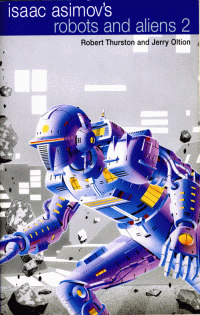
Fairly early in Intruder we saw that there was a third Silverside that had taken over Robot City. After an intense search Derec finally reclaimed control with the help of his friends. Now, Derec is faced with three robots without solid definitions of “human”. I think that this novel is quite a bit more philosophical in the search for what makes someone human. Not too much happens plot-wise, most of the bulk is focused on defining what is human. We do get a slightly better glimpse at the origins of the Silversides and a hint at where the series might end up toward the end.


I remember reading “The Last Question” when I was 9 or 10 years old. I thought it was a GREAT story then and I think it’s a GREAT story now.