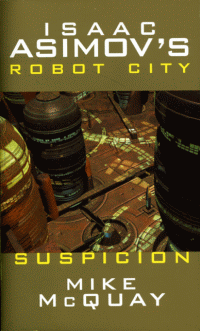
The Science Fiction Review Books,Robot and Foundation,Robot City Isaac Asimov’s Robot City Book 2: Suspicion by Mike McQuay

Isaac Asimov’s Robot City Book 2: Suspicion by Mike McQuay

Robot City 2: Suspicion book cover

This review will most likely contain spoilers for any previous books in the series, read at your own risk.

After escaping from the alien Aranimas, and subsequently the space station that rescued them, Derec and Katherine find themselves miraculously transported to Robot City. They used the Key to Perihelion, a device that somehow allowed them to travel instantly across the galaxy. I like this idea because it is twist on space travel that allows the authors to work out unique plot elements throughout the rest of the series. Derec and Katherine arrive to find themselves the only 2 suspects in the murder of a human in a city full of robots.

It seems they’ve just traded one prison for another. Since they are the only humans on the planet, according to logic the robots think that one of them must have commited the murder, because no robot could have. This book revolves around Derec and Katherine’s investigation into the murder they are accused of at the end of Odyssey. Suspicion reminds me a bit of Elijah Baley’s murder investigations in Asimov’s original Robot Novels. The style is notably different, but the murder-mystery element kept me thinking back to the originals.
1 thought on “Isaac Asimov’s Robot City Book 2: Suspicion by Mike McQuay”

  1. In this second book of the Robot City series, we see the Robots in a different settting than ever before. Stranded in a living city, Katherine and Derec find themselves trying prove themselves to be innocent in a murder investigation. The Robots propose the Laws of Humanics as they try to understand the peculiarities of humans. This book pulled me into the series even more, and answers are starting to emerge.

Leave a Reply

Your email address will not be published. Required fields are marked *

Please prove you are a human * Time limit is exhausted. Please reload the CAPTCHA.

This site uses Akismet to reduce spam. Learn how your comment data is processed.

Related Post

Children of Dune by Frank HerbertChildren of Dune by Frank Herbert

Frank Herbert caps off his Dune Trilogy with Children of Dune. Paul “Muad’Dib” Atreides embraced his fate as a blind Fremen by walking into the desert approximately 9 years ago. His sister Alia oversees the religion of Muad’dib, and seems to be enjoying the power that comes with it as the de facto leader of the Empire. Paul’s twin children Leto II and Ghanima are being protected by Stilgar at Sietch Tabr. The main concern, which is well justified, is the fear that the Atreides twins will be assassinated. (more…)

Starship Troopers by Robert A. HeinleinStarship Troopers by Robert A. Heinlein

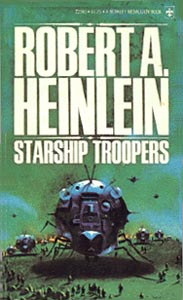
Starship Troopers book cover

The 1959 novel Starship Troopers is a military-based science fiction novel which won the Hugo Award for best novel in 1960. Robert A. Heinlein clearly draws from his previous military experience to describe the career of Juan “Johnny” Rico as he works his way up from a fresh recruit to 2nd Lieutenant in the Terran Federation military during the “Bug War”.

The story is told through a series of flashbacks narrated by Rico, intertwined between these are obvious commentaries on discipline, politics, and human behavior. Heinlein’s concepts, specifically mechanical armor, influenced science fiction in various realms ranging from other novels to games, and even spawned a Hollywood motion picture. I’ve seen the movie Starship Troopers (1997) before, and will watch it again soon, so keep an eye out for that review. (more…)

Isaac Asimov’s Inferno by Roger MacBride AllenIsaac Asimov’s Inferno by Roger MacBride Allen

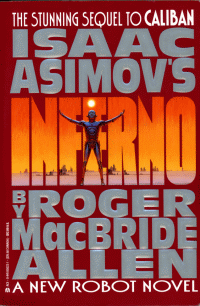
Inferno book cover

    The New Laws of Robotics

  1. A robot may not injure a human being.
  2. A robot must cooperate with human beings except where such cooperation would conflict with the First Law.
  3. A robot must protect its own existence, as long as such protection does not conflict with the First Law.
  4. A robot may do as it likes, except where such action would violate the First, Second, or Third Laws.

About a year has passed since Caliban was exonerated. The Limbo project is currently using the New Law robots developed by Freda Leving in the hopes of fixing the terraforming problem. Although these robots are equipped with range restrictors to limit them to the island, an illicit smuggling trade has developed which smuggles robots out of Purgatory and helps remove the supposedly infallible restrictors. This criminal enterprise has caused much strain between Spacers and Settlers. (more…)