The Science Fiction Review Robot and Foundation,Robot City Isaac Asimov’s Robot City Book 1: Odyssey by Michael P. Kube-McDowell

Isaac Asimov’s Robot City Book 1: Odyssey by Michael P. Kube-McDowell

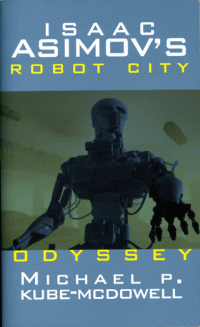
Robot City 1: Odyssey book cover

A man wakes up in an escape pod with no memory, and only his space suit with Derec written on it to tell him what his name is. He has no memory whatsoever of anything before he woke up. The main plot of the series revolves around Derec’s search for his identity and a way to recover his memory. We are introduced to robots that don’t necessarily behave how we would have thought. They do obey the Three Laws but there are new twists involved. We also get to see aliens, something that Asimov had not really explored in his own writing. Overall, there is quite a bit of action in this first book and it should keep you interested enough to finish the rest of the series.
1 thought on “Isaac Asimov’s Robot City Book 1: Odyssey by Michael P. Kube-McDowell”

  1. I was a little skeptical reading a book based on Asimov’s work, but written by someone else; however, I can tell from the first book that I am going to like the series. This book can be classified as an introduction, and ends with a series of questions and mysteries yet to be resolved. Basically, Derec finds himself on an asteroid with no previous personal memories, but an obvious robotics abilities. Many things about the asteroid’s operations are abnormal. I have some theories already as to what is going to happen, and I can’t wait to see what happens next!

Leave a Reply

Your email address will not be published. Required fields are marked *

Please prove you are a human * Time limit is exhausted. Please reload the CAPTCHA.

This site uses Akismet to reduce spam. Learn how your comment data is processed.

Related Post

Foundation and Earth by Isaac AsimovFoundation and Earth by Isaac Asimov

Foundation and Earth Book Cover

Background:
This is the final novel in the Foundation Universe chronologically speaking. There are a couple short stories completed by other authors, but Foundation and Earth describes (in 494 pages) where Asimov saw his epic saga moving toward. It is a shame that he couldn’t have lived longer to continue on writing. For those that don’t know, Isaac Asimov contracted HIV from a blood transfusion during a heart operation in 1983. It later developed into AIDS, causing heart and kidney failure which led to his death in 1992. For more information on his life and death, visit Asimov Online. I wish I could remember the source, but I know I read that Asimov was not sure exactly how he would continue the series when a fan suggested he go back and write some prequels. Before his death he did fill in some gaps with the Prelude to Foundation and Forward the Foundation.

Review:
Almost no time has passed since Golan Trevize made his decision in favor of Galaxia over a Second Galactic Empire controlled by either the First or Second Foundation. Trevize is still on Gaia along with Janov Pelorat and Bliss. Golan intends to find Earth so that he can find out why he chose felt that Galaxia was best for not only mankind, but for every living thing in the Galaxy. He will not rest until he finds Earth. Bliss insists on going on his search to act as protection through her role as part of Gaia, and Janov has his own research on Earth that he wishes to complete.

The one thing that Asimov succeeds accomplishing in this novel, as he does with the others books in this series, is creating and describing different cultures. These cultures vary from the extremes of conservatism to tribal utopias. Each new world has its own customs, mythology, and history which is described through the interactions between the protagonists and the natives encountered throughout their complex journey. (more…)

Isaac Asimov’s Robots and Aliens Book 1: Changeling by Stephen LeighIsaac Asimov’s Robots and Aliens Book 1: Changeling by Stephen Leigh

Robots and Aliens Volume 1 book cover

One thing I like about this book is there is a nice eight page synopsis of the whole Robot City series. Even after just reading the series, it was a nice refresher for the events leading up to Robots and Aliens. This new series involves Asimov’s challenge to the authors to describe what might happen if robots encountered an alien species. How would they treat them? How would the Three Laws apply?

I particularly enjoyed this first book because it addresses one of the main questions I had regarding the Three Laws of Robotics. What does the key phrase “human being” actually mean? Throughout Asimov’s books and it is explained that the laws aren’t as simple as the English translation. They are complicated sets of positronic potentials that govern every action of a robot.

In Changeling, Stephen Leigh describes a robot model that is given a very simple definition of “intelligent life form” as an equivalent. This idea seems to work very well in this book and after several chapters we see how this experiment intersects with the Robot City plotlines. Also, we get to see Derec use the powers he was given to control Robot City. One thing that did bug me a little bit was how little of the main plotlines was advanced.

Isaac Asimov’s Robots and Aliens Book 5: Maverick by Bruce BethkeIsaac Asimov’s Robots and Aliens Book 5: Maverick by Bruce Bethke

Robots and Aliens Volume 3 book cover

This review will most likely contain spoilers for any previous books in the series, read at your own risk.

Toward the end of Alliance, Derek agrees to transport the three shape changing robots to the cannoid inhabited planet that Adam originally emerged from. The title of the book refers to a subplot about a loner named Maverick, which was expelled from a main pack some time ago. His goal is to join PackHome. I really didn’t identify with this character at all. In the meantime the Robots on the planet agree to treat the cannoid inhabitants as humans in order to give themselves a purpose.

Overall this book has a little bit of action, but seems to me to be nothing more than a stepping stone before the final book. I didn’t really enjoy it that much because nothing seemed to really happen. I’m looking forward to the final book to see how all of this will finally be tied together.