The Science Fiction Review Books,Robot and Foundation,Robot City Isaac Asimov’s Robot City Book 2: Suspicion by Mike McQuay

Isaac Asimov’s Robot City Book 2: Suspicion by Mike McQuay

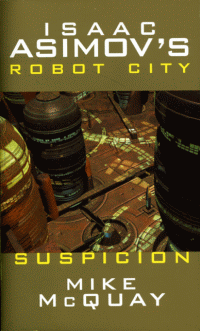
Robot City 2: Suspicion book cover

This review will most likely contain spoilers for any previous books in the series, read at your own risk.

After escaping from the alien Aranimas, and subsequently the space station that rescued them, Derec and Katherine find themselves miraculously transported to Robot City. They used the Key to Perihelion, a device that somehow allowed them to travel instantly across the galaxy. I like this idea because it is twist on space travel that allows the authors to work out unique plot elements throughout the rest of the series. Derec and Katherine arrive to find themselves the only 2 suspects in the murder of a human in a city full of robots.

It seems they’ve just traded one prison for another. Since they are the only humans on the planet, according to logic the robots think that one of them must have commited the murder, because no robot could have. This book revolves around Derec and Katherine’s investigation into the murder they are accused of at the end of Odyssey. Suspicion reminds me a bit of Elijah Baley’s murder investigations in Asimov’s original Robot Novels. The style is notably different, but the murder-mystery element kept me thinking back to the originals.
1 thought on “Isaac Asimov’s Robot City Book 2: Suspicion by Mike McQuay”

  1. In this second book of the Robot City series, we see the Robots in a different settting than ever before. Stranded in a living city, Katherine and Derec find themselves trying prove themselves to be innocent in a murder investigation. The Robots propose the Laws of Humanics as they try to understand the peculiarities of humans. This book pulled me into the series even more, and answers are starting to emerge.

Leave a Reply

Your email address will not be published. Required fields are marked *

Please prove you are a human * Time limit is exhausted. Please reload the CAPTCHA.

This site uses Akismet to reduce spam. Learn how your comment data is processed.

Related Post

Extraterrestrial Civilizations by Isaac AsimovExtraterrestrial Civilizations by Isaac Asimov

Published 39 years ago in 1979, Isaac Asimov discussed the possibilities of finding intelligent life in his book Extraterrestrial Civilizations. This has been on my reading list for quite a long time, but I just now got the notion to mark it off. Having read literally all of Asimov’s fiction, I thought it was time to read more of his non-fiction. Unwittingly, I finished this just a week or two before his birthday, which by the way was 99 years ago today!

I was thinking Extraterrestrial Civilizations would be a discussion on what civilizations might be like when if/when we discover them, or they discover us. It turned out to be more of a thought experiment, methodically laying out probabilities based on list of assumptions. Most of these assumptions were made with what scientific knowledge there was available at the time. Asimov was very careful to speckle the book with asterisks noting that if certain assumptions would change in the future, the predictions would be changed or invalidated. (more…)

Isaac Asimov would have been 90 todayIsaac Asimov would have been 90 today

Nobody is sure when exactly Isaac Asimov was born due to poor record keeping. January 2nd, 1920 was the day Isaac Asimov decided to celebrate his birthday. Along with creating the Three Laws of Robotics, Asimov also unintentionally coined the term robotics. It was first used in print when his short story “Liar!” was published in 1941. He was constantly writing in just about every area of literature. I have primarily read his Science Fiction, but he has done textbooks, humor, mystery, non-fiction, and more.

My first exposure to Asimov’s writing was when my father gave me an old worn out copy of I, Robot. I tucked the book away for a few years and eventually got around to reading it. I was so enthralled with the robots that I eventually read every robot book by him and other authors. This naturally led me to read the Foundation series which I also enjoyed, but I’ve always preferred the robot series. The Robot and Foundation books make up the biggest reading project I have ever completed. Aside from those, I’ve read a bit of his autobiography and plan on sampling some of his other writing in the near future.

By the time I discovered Asimov, he had already died. I wonder how much more he could have written had he not contracted HIV from a blood transfusion he received during heart surgery. He died of myocardial and renal complications on April 6, 1992, but the true cause of his death wasn’t publicized due to the stigma of HIV/AIDS at the time. His work has greatly influenced my love of Science Fiction, and for that I am thankful.

For more information on the life of Isaac Asimov, please visit the official Wikipedia post

The Stars, Like Dust by Isaac AsimovThe Stars, Like Dust by Isaac Asimov

The Stars, Like Dust book cover

Timeline discussion:
Here are a couple quotes — “Atomic warfare had done its worst to Earth. Most of it was hopelessly radioactive and useless.” and “The radioactivity of the soil was a vast sea of iridescent blue, sparkling in strange festoons that spelled out the manner in which the nuclear bombs had once landed, a full generation before the force-field defense against nuclear explosions had been developed, so that no other world could commit suicide in just that fashion again.” — The Stars, Like Dust (more…)