Tim Pratt recently won the 2007 Hugo Award for best short story with Impossible Dreams. The story’s main character, Pete, is a huge movie buff that stumbles across a new video store in his neighborhood. He doesn’t seem to understand how he missed the store before, but ventures in and finds an odd selection of movies which he though had been canceled, or made by different directors with different actors. What follows is an interesting commentary on movies which either were never made, were lost, or simply done differently. This is a truly awesome story with an excellently planned ending. It was a pleasure to read from start to finish. From the writing it either the author is a huge movie buff or his writing is so good that you’d never even suggest he wasn’t passionate about movies. Visit the link above and read the full story at Asimov’s Science Fiction.
Impossible Dreams by Tim Pratt
Related Post
Manta’s Gift by Timothy ZahnManta’s Gift by Timothy Zahn

It has been a while since I have read anything by Timothy Zahn. I loved his Star Wars Thrawn Trilogy and Hand of Thrawn Duology. I also enjoyed the Conquerors’ Trilogy. I’d like to go back and re-read those sometime in the future, but for now I’m focusing on chipping away at my collection of books I haven’t read yet. I was very pleased at how well Zahn developed the Zhirrzh in the Conquerors’ Trilogy, so I was curious to see how well he does here in Manta’s Gift.
The Qanska are not the typical aliens you would expect so see in a Sci-Fi novel. They look like huge manta rays flying through the various levels of ever thicker atmosphere in Jupiter. The vast majority of aliens that I have read about have been humanoid. The ones that are not humanoid are usually portrayed as monsters (Starship Troopers), or there is a huge communication gap. Zahn challenges this stereotype and succeeds in describing a completely unique and intelligent alien race.
(more…)
Foundation’s Fear by Gregory BenfordFoundation’s Fear by Gregory Benford
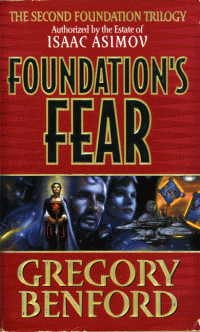
The Second Foundation Trilogy is a venture initiated by Asimov’s Estate. Gregory Benford was approached to work on the project, and eventually Greg Bear and David Brin finished the series. I remember from my previous experience with Foundation’s Fear back in 2000 or so that I didn’t like it. I made a point of keeping track of details that bugged me throughout the novel so that I could provide some constructive criticism. I tried to do my best to keep an open mind, but it wasn’t long before I remembered why I didn’t like this novel. There will be minor spoilers, but hopefully they will help you save some time reading this 597 page (paperback) monster. (more…)
Thrawn Trilogy by Timothy ZahnThrawn Trilogy by Timothy Zahn

“HeirToTheEmpire” by Source. Licensed under Fair use via Wikipedia.

When I heard about production of Star Wars Episode VII and the ensuing controversy about the Expanded Universe vs canon, I started thinking about reading Timothy Zahn’s Thrawn Trilogy again. I first read the books almost 25 years ago! I decided that I didn’t really care if the new movies conflicted with the books. I remembered being blown away, so figured they were worth reading again. These books were a very important to me at the time because it was my first real taste of Star Wars outside of the theatrical films. There were other books released before this, but the Thrawn Trilogy marked the resurgence of my interest in Star Wars.
I’ll admit that I’ve been a bad reviewer and powered through the series without stopping to write my reviews. I normally read on my lunch breaks at work and have not had hardly any time outside of work and family life to devote to reviews as I did just a few years ago.
After reading just a few chapters of Heir to the Empire, I realized that there was quite a bit that I didn’t remember, including a rather large plot line that ran through the last two books (Dark Force Rising and The Last Command). Toward the end of The Last Command, I came across a huge plot twist that I had absolutely no memory of until just before it was revealed. I’m simply amazed at how much of this series I couldn’t remember. In a way, it was a blessing because I almost experienced the book for the first time again. This was kind of weird for me as I always thought I had an excellent memory when it came to books. I gave my wife a hard time about not remembering some fairly important stuff in the Wheel of Time series, despite her reading it at least 3 times through from beginning to end as new books came out. At the time I had only read the series once through. (more…)