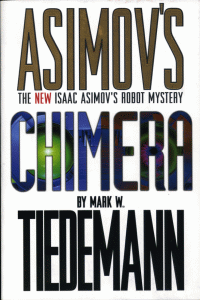
Asimov’s Chimera by Mark W. Tidemann

Chimera book cover

Chimera opens up with a flashback to twenty-five years ago to the scene kidnapping of twenty babies from a hospice center. Back at present day, Coren Lanra, security chief for Rega Looms at DyNan Corporation, is working on tracking the actions of Rega’s daughter Nyom. Unfortunately, Nyom ends up dead along with all those she was attempting to help smuggle to the settler colony Nova Levis. The only possible clue lies in the brain of a robot that locked up while trying to save the passengers. Surprisingly, Ariel and Derec are encouraged to help Coren in his investigation by Ambassador Setaris Coren is forced to follow his own leads while Derec attempts to recover the failed robot’s memories. The following investigation eventually reveals the link to the kidnappings, with danger at almost every turn.

Overall, I would say that this second book has a much more complicated set of plot lines than Mirage. I like the Coren Lanra character the best out of all the others in this series. He’s a man of integrity that does what needs to be done without worrying about the consequences to him. The technology he uses for his investigation is very interesting and seems to fit well into the time period. I can see how some of his little gadgets might actually exist some day considering the way nanotechnology is coming along. The gadgets seemed a bit more futuristic when this book was published in 2001. This book also seemed to focus a lot less on Three Law conflicts than Mirage. I would say that is a compliment because some times these “authorized” novels can sometimes focus on them to the point of being repetitive. Mark W. Tiedemann seems to realize that if someone is reading this they probably know the Three Laws inside and out already.

Further discussion of plot points: ***Note Possible spoilers for Chimera, The Naked sun, Robots and Empire, and Robot City series***

As stated in my previous review the Solarians are reclusive to the point that ANY human contact is repulsive. Tiedemann appears to try and cover for this with the following sentence, “To be sure, those Solarians living here did not share the degree of paranoia exhibited … but they still came across as standoffish and mistrustful.” (Chapter 8, pg 123) Also Coren remembers that Solarians have an “aversion to being touched” (Chapter 15, pg. 242) when the Solarian ambassador fails to shake his hand. Anyone that hasn’t read The Naked Sun might not realize that these statements are a bit of an understatement. Almost all Solarians are afraid to even see another in person, except for specified times to meet with their spouse. From what I remember Gladia was one of the few Solarians to leave and her willingness to “See” (in person) people was considered perverse.

Another problem is with Derec saying, “It’s the first place (Earth) I really came to know after I recovered from amnemonic plague (Burundi’s Fever). I may as well have been born here.” (Chapter 11, pg 178) From the Robot City novels the doctors on Earth were amazed with Derec because he had antibodies but had never actually had the disease. His hospitalization was due to the interference of the “chemfets” that were injected into Derec back on Robot City before he and Ariel escaped. His memory loss was later found to be caused by insane father, Dr. Avery, in an attempt to keep him from Ariel/Katherine.
Leave a Reply

Your email address will not be published. Required fields are marked *

Please prove you are a human * Time limit is exhausted. Please reload the CAPTCHA.

This site uses Akismet to reduce spam. Learn how your comment data is processed.

Related Post

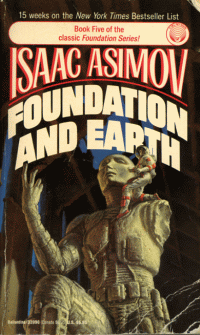
Foundation and Earth by Isaac AsimovFoundation and Earth by Isaac Asimov

Foundation and Earth Book Cover

Background:
This is the final novel in the Foundation Universe chronologically speaking. There are a couple short stories completed by other authors, but Foundation and Earth describes (in 494 pages) where Asimov saw his epic saga moving toward. It is a shame that he couldn’t have lived longer to continue on writing. For those that don’t know, Isaac Asimov contracted HIV from a blood transfusion during a heart operation in 1983. It later developed into AIDS, causing heart and kidney failure which led to his death in 1992. For more information on his life and death, visit Asimov Online. I wish I could remember the source, but I know I read that Asimov was not sure exactly how he would continue the series when a fan suggested he go back and write some prequels. Before his death he did fill in some gaps with the Prelude to Foundation and Forward the Foundation.

Review:
Almost no time has passed since Golan Trevize made his decision in favor of Galaxia over a Second Galactic Empire controlled by either the First or Second Foundation. Trevize is still on Gaia along with Janov Pelorat and Bliss. Golan intends to find Earth so that he can find out why he chose felt that Galaxia was best for not only mankind, but for every living thing in the Galaxy. He will not rest until he finds Earth. Bliss insists on going on his search to act as protection through her role as part of Gaia, and Janov has his own research on Earth that he wishes to complete.

The one thing that Asimov succeeds accomplishing in this novel, as he does with the others books in this series, is creating and describing different cultures. These cultures vary from the extremes of conservatism to tribal utopias. Each new world has its own customs, mythology, and history which is described through the interactions between the protagonists and the natives encountered throughout their complex journey. (more…)

1984 by George Orwell1984 by George Orwell

Book Cover
I’m not sure why, but I have just got around to reading 1984. For some reason it was never required reading for me in high school. I was familiar with the “Big Brother” concept as it is a very common reference. Recently, the Patriot Act of 2001 and subsequent reauthorization in 2005 has been criticized by many. For me, 1984 was a very interesting read, because a lot of George Orwell’s concepts seem very plausible today.

I can’t really emphasize enough how important it is to read the Appendix of 1984 first. It covers the official government language of Oceana. This is called “Newspeak,” and is designed to simplify the English language and control human thought. As a quick example, there is no word for bad, just ungood. Excellent would be replaced by something like doubleplusgood. Another important word central to the plot is doublethink, or the ability to hold two contradicting ideas in one’s mind and truly believe both.

The story takes place in Oceana, one of three superpowers that is always at war with either Eastasia or Eurasia. The Party controls all information and feeds political propaganda to the public and keeps the public under constant surveillance through telescreens which act as both televisions and video cameras. The main character, Winston Smith, works for the Party in the Ministry of Truth.

The description of the Ministry of Truth was very scary. Essentially it is responsible for storing all information and knowledge, and subsequently can modify any of it to suit its own purpose. For example, Oceana can swith alliances with one of the other two superpowers, and all of historical information would be changed. Winston’s job is to modify records to match Party policy whenever changes or errors are made. He secretly despises Big Brother and the Party, and is eventually approached by a woman named Julia who shares his feelings. They eventually become lovers, but Winston is a bit concerned. She does not seem to be as aware of the political brainwashing as he is.

It was rather more of a shock to him when he discovered from some chance remark that she did not remember that Oceania, four years ago, had been at war with Eastasia and at peace with Eurasia. It was true that she regarded the whole war as a sham: but apparently she had not even noticed that the name of the enemy had changed. ‘I thought we’d always been at war with Eurasia,’ she said vaguely. It frightened him a little.

They eventually make contact with O’Brien, a secret member of an underground resistance. He warns them that they will get caught eventually, and they will confess (under torture), and for that reason their knowledge of who are members will be kept to the absolute minimum. They are given “THE BOOK” which contains the musings of Goldstein, the leader of the resistance. The excerpts that Winston reads describe some very morbid ideas about war, which are very interesting. There are quite a few other tidbits in there as well.

Orwell’s 1984 is very deep and thought provoking. If anything, it is more relevant today, than when it was published in 1949. Technology is advancing at an alarming rate. Within the last few years, the FBI obtained warrants to wiretap cell phones of mobsters under investigation. This might seem innocuous, but the technique they used was able to activate the microphone on the phones remotely without a call being placed, and might have been possible to record conversations near the phone while it was turned off! Just recently, in The Dark Knight, Bruce Wayne develops a technology that ties into cell phones to create a much more elaborate surveillance system. How long it will be until something like that is possible?

I’m partial to reading physical books, but if you like to read ebooks, 1984 is available at Project Gutenberg.

Tau Zero by Poul AndersonTau Zero by Poul Anderson

Book Cover

I came across a recommendation for Tau Zero by Poul Anderson on a top 10 list of science fiction novels. I was a bit intrigued because I recognized all of the authors on the list except this one. I did a little bit of research and found that this novel was more of “hard” science fiction. I wasn’t sure exactly what to except, and after just a few chapters I was pleasantly surprised.

A group of 25 male and 25 female scientists are selected to go on an interstellar colonization mission. Their ship, the Lenora Christine, is equipped with an advanced Buzzard engine. This engine is designed to feed off of hydrogen particles in its path while at the same time repelling other particles that would normally tear the ship apart at high velocities. The ship is designed to travel at near the speed of light, and relativity plays a significant role in the plot. After striking a nebulae that was a bit too dense for the Buzzard engine to redirect enough particles, the decelerator was damaged. There was no way to slow down. If they shut the Buzzard engine down to make repairs, they would be killed in minutes without the shielding. (more…)