The Science Fiction Review Books,Robot and Foundation Robots in Time: Predator by William F. Wu

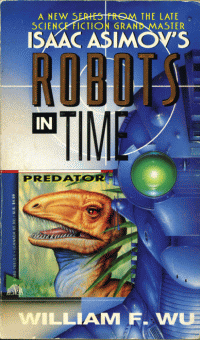
Robots in Time: Predator by William F. Wu

Robots in Time Predator book cover

This book is great for teens, not for adult readers or die-hard fans. I acquired this book along with about 16 Isaac Asimov classics (Foundation series, Caves of Steel, etc), otherwise I probably never would have purchased it. If you are a die-hard fan like me, you will find this book/series unbearable. The book is written for a young reader according to the author, so my reaction is to be expected. The main characters act out every single 3 law conflict over and over throughout the novel. Every situation is explained in detail with reason why Robot X can or can’t do this or that because of Law X.

For a new reader that isn’t familiar with Asimov this book would probably be very informative. If you are interested in Time travel, buy “The End of Eternity” by Isaac Asimov. If you want to read up on the Three Laws, buy “I, Robot”. If you want a combination of both for a younger reader, buy this book. I would suggest this book for readers around the age of 12-16 after they have read “I, Robot”.
Leave a Reply

Your email address will not be published. Required fields are marked *

Please prove you are a human * Time limit is exhausted. Please reload the CAPTCHA.

This site uses Akismet to reduce spam. Learn how your comment data is processed.

Related Post

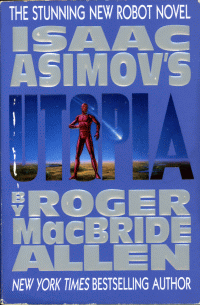
Isaac Asimov’s Utopia by Roger MacBride AllenIsaac Asimov’s Utopia by Roger MacBride Allen

Utopia book cover

About five years has passed since the New Law robots were put to work at Purgatory to assist with the terraforming effort for Inferno. Alvar Kresh won the election for governor and ended up choosing a dual terraforming system combining a positronics with a super computer. In an unexpected turn, Kresh ended up marrying Fredda Leving. Initially I thought that they made a rather odd couple, but I think Allen did a good job of handling their relationship throughout this book. The main plot Utopia revolves around a plan by a scientist to harness a comet and blow it apart to dig a huge channel from the southern ocean to the frozen northern ice cap which would otherwise be impossible by conventional means. (more…)

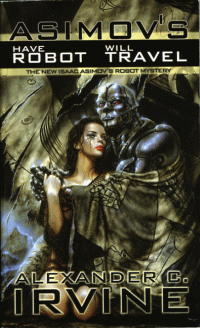
Have Robot, Will Travel by Alexander C. IrvineHave Robot, Will Travel by Alexander C. Irvine

Have Robot, Will Travel book cover

Derec and Ariel have been exiled to Nova Levis, the site of the cyborg lab that was uncovered at the end of the previous series by Tiedemann. Derec has been focusing the resources of his lab on containing the mutating plagues released by Kynig Pyrapoyos. There is a murder on Kopernik station which appears to be committed by a robot, which Derec is summoned to investigate. In the meantime Ariel is asked to look into the possibility of cyborg survivors getting the right to vote.

One of my main disappointments with this book is that the plot lines don’t seem to pick up in pace until about the last quarter of the book. Irvine doesn’t seem to demonstrate the knack for complexity and pacing that Tiedemann did during the last trilogy. Besides these things the book was overall an enjoyable read. If I could pick out one good thing it would be that the plot lines switch back and forth often enough so that you aren’t stuck wondering what is happening in the other one for too long.

***Spoiler discussion for this novel & Robots and Empire**** (more…)

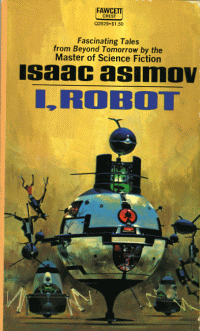
I, Robot by Isaac AsimovI, Robot by Isaac Asimov

I-Robot Book Cover

    The Three Laws of Robotics

  1. A robot may not injure a human being, or, through inaction, allow a human being to come to harm.
  2. A robot must obey the orders given it by human beings except where such orders would conflict with the First Law.
  3. A robot must protect its own existence as long as such protection does not conflict with the First or Second Law.

First things first, the Hollywood movie I, Robot (also reviewed) with Will Smith has only has a few things in common with this book of short stories. Keep in mind that the NAME was licensed to the movie studio after the script was already written. Scenes were adjusted to include the Three Laws, Susan Calvin, and Alfred Lanning. That is about where the similarities between the book and the movie end. There might be a few concepts stripped from some of the stories, but by no means is the film “based” on the book. To give the movie makers credit, they only say “inspired” by in the opening.

I, Robot is a collection of short stories by Isaac Asimov. Keep in mind these stories were mainly written in the 1940s then published together in 1950. These stories describe the basics of the Three Laws of Robotics and what can go wrong with them. Asimov uses the Three Laws as a literary device to create puzzling situations. Several of these stories involve Susan Calvin, the top robo-psychologist for the only robot manufacturing company, US Robots and Mechanical Men, Inc. If anyone is interested in reading the Robot Novel series, this book kind of acts as a nice introduction to the basic concepts. As a matter of fact, anyone with any interest in Sci-Fi should read this book. I consider it required reading.