The Science Fiction Review Robot and Foundation,New Robot Mysteries Have Robot, Will Travel by Alexander C. Irvine

Have Robot, Will Travel by Alexander C. Irvine

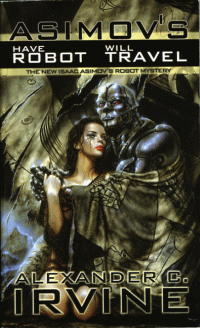
Have Robot, Will Travel book cover

Derec and Ariel have been exiled to Nova Levis, the site of the cyborg lab that was uncovered at the end of the previous series by Tiedemann. Derec has been focusing the resources of his lab on containing the mutating plagues released by Kynig Pyrapoyos. There is a murder on Kopernik station which appears to be committed by a robot, which Derec is summoned to investigate. In the meantime Ariel is asked to look into the possibility of cyborg survivors getting the right to vote.

One of my main disappointments with this book is that the plot lines don’t seem to pick up in pace until about the last quarter of the book. Irvine doesn’t seem to demonstrate the knack for complexity and pacing that Tiedemann did during the last trilogy. Besides these things the book was overall an enjoyable read. If I could pick out one good thing it would be that the plot lines switch back and forth often enough so that you aren’t stuck wondering what is happening in the other one for too long.

***Spoiler discussion for this novel & Robots and Empire****
I think the biggest question I have so far from Mirage up to this book is; what are Daneel and Giskard doing at this point? Are they aware of this society of robots which is being led by Bogard and Hofton? It is obvious that in this series the Zeroth law has been determined independently before Giskard and Daneel do at the end of Robots and Empire. The same conclusion is reached: isolate the spacers and allow the settlers to populate the galaxy. I am still wondering what will keep the aliens from Robots and Aliens isolated from the Settler expansion. Despite these nagging questions I think that all of these books so far have been an enjoyable read.
1 thought on “Have Robot, Will Travel by Alexander C. Irvine”

  1. I really enjoyed this book! I thought it was interesting how cyborgs were trying to get the same rights as humans but the humans would rather kill them all than allow that. At the same time other robots were trying to redefine what a human is…the storyline was intriguing!

Leave a Reply

Your email address will not be published. Required fields are marked *

Please prove you are a human * Time limit is exhausted. Please reload the CAPTCHA.

This site uses Akismet to reduce spam. Learn how your comment data is processed.

Related Post

Isaac Asimov’s Robot City Book 3: Cyborg by William F. WuIsaac Asimov’s Robot City Book 3: Cyborg by William F. Wu

Robot City 3: Cyborg book cover

This review will most likely contain spoilers for any previous books in the series, read at your own risk.

This book has a nice intro from Asimov talking about cyborgs that is quite interesting. I always like reading these. Derec and Katherine have proven they didn’t commit murder, and stopped the rapid expansion of the city. They still stuck in Robot City though and are still searching for a way out. They are sidetracked by a rogue cyborg that escaped from a medical facility. I like the repercussions that are explored by transplanting a human brain into a robot body. The book goes by really quickly with lots of action and a few tidbits of information to keep the main plotlines going also.

Robot City series overview (spoiler free)Robot City series overview (spoiler free)

I thought it would be appropriate to write a little mini review of the entire Robot City series before starting on the individual books since I have read this series once before. I won’t go into any spoilers, just give a general feel for the series. Each novel begins with an introduction by Isaac Asimov which is a nice addition to each of the novels. As stated in the introduction for the first book, this series is the first time Asimov has allowed any other authors to write in the world he created. Essentially he had final say on anything that went into the books and was consulted to make sure the authors didn’t overstep their authority. The introductions themselves sometimes reveal minor plotline spoilers for the current book, but nothing major except for book six. I recommend reading the book six intro after you finish, but that’s up to you.

This series is really meant to be read as whole. It takes place approximately 20 years before Robots and Empire by Isaac Asimov. I chose to read Robots and Empire before this series. The first book really gives you a glimpse at what might happen in the following books. Book one is full of questions, very few answers, and can be best described as an “introduction” like the first 20 minutes of a movie. I was hooked on the series after the first book. Each book is only about 200 pages with short chapters so it is easy to just pick it up and read a little bit without having to stop in the middle of a chapter. There is a general consistency in the writing of the various authors in all 6 of the novels comprising the series. It really doesn’t feel like you are adjusting to a new author for each book. Overall, the series is a worthwhile addition to the universe that Asimov created.

Foundation’s Edge by Isaac AsimovFoundation’s Edge by Isaac Asimov

Foundation's Edge book cover

In the order of publishing, Foundation’s Edge represents a return by Asimov to the Foundation novels dating back to 1950. This was the novel in which he officially linked the Robot Novels, Empire Novels, and Foundation Novels together into one universe. I believe it was this choice that helped him to win the Hugo Award for Best Novel in 1983. I liked Foundation’s Edge, but I prefer Foundation and Empire’s “The Mule” or Second Foundation’s “Search by the Foundation” to this book. Actually, while researching the Hugo Award for this novel I found out that according to Wikipedia, The Mule (1946) [part 2 of Foundation and Empire] received one of only three “Retro Hugo” awards.

As with most of the other Foundation novels, Foundation’s Edge follows the events of the Foundation (oddly not usually referred to as the First Foundation) and the Second Foundation. The Foundation plot line follows Golan Trevize, a councilman on Terminus, the capital of the Foundation Federation. A Seldon crisis has just passed involving a dispute over whether or not to move the capital of the Foundation Federation to a world closer to the center of the galaxy. Seldon appeared in the time vault and described what had taken place with eerie accuracy. How could Seldon have predicted with such accuracy almost 500 years into the future especially when The Mule had wreaked such havoc to the Plan? (more…)