The Science Fiction Review Books,Robot and Foundation,Robot City Isaac Asimov’s Robot City Book 6: Perihelion by William F. Wu

Isaac Asimov’s Robot City Book 6: Perihelion by William F. Wu

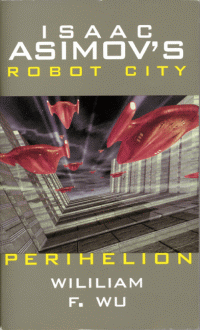
Robot City 6: Perhelion book cover

As I stated in the general Robot City review, Isaac Asimov’s introduction to this book contains some major spoilers for the novel. Especially if you are reading the entire robot series in chronological order, I suggest not reading Asimov’s introduction unless you have finished both this novel and Robots and Empire. There are many spoilers for the rest of the Robot Novel series by Asimov also. This review will most likely contain spoilers for any previous books in the Robot City series, read at your own risk.

Doctors on Earth were able to cure Ariel of her sickness, but her memory was lost. Derec has shown signs of a sickness also, but doctors have assured him it is not what Ariel had. They finally escape and eventually Derec, Ariel, Mandelbrot, and Wolruf decide to return to Robot City to attempt to find a cure for Derec.

This book concentrates mainly on answering most of the questions that were developed in the rest of the series. Robot City appears to have covered the entire surface of the planet at this point. Derec must find out what Dr. Avery has done to him with the help of his friends. Some things are left unanswered, which frustrated me a bit. This seems a bit fitting because the climax opens the door for the next series, Robots and Aliens.
Leave a Reply

Your email address will not be published. Required fields are marked *

Please prove you are a human * Time limit is exhausted. Please reload the CAPTCHA.

This site uses Akismet to reduce spam. Learn how your comment data is processed.

Related Post

Foundation’s Triumph by David BrinFoundation’s Triumph by David Brin

Foundation's Triumph book cover

David Brin does a good job of unifying the Robot and Foundation novels by explaining many of the contradictions which come up if we assume every book written so far is to be viewed as in the same universe. One of the nagging questions which bothered me while reading the series is, “How did 25 million worlds get settled in just 20,000 or so years?” Brin explains this and many other things throughout the novel. At some points it seemed that he was reaching very hard to explain every single little detail linking the other novels together. Overall the book was enjoyable, but I think that the last one was significantly better. (more…)

Isaac Asimov’s Robots and Aliens Book 2: Renegade by Cordell ScottenIsaac Asimov’s Robots and Aliens Book 2: Renegade by Cordell Scotten

Robots and Aliens Volume 1 book cover

This review will most likely contain spoilers for any previous books in the series, read at your own risk.

In Renegade, Cordell Scotten describes an alien species far different than that of the wolf-like pack in Book1. I found it a bit hard to relate to this new species as well as I could with the wolf creatures. I think that Scotten might have been trying a bit too hard to come up with complex aliens. Most of the unique mannerisms that were described seemed like they came out of nowhere. One thing that I did like from this book was that the relationship between Derec and Ariel is developed a bit more. Also, we start to understand a bit more about the Key of Perihelion.

Have Robot, Will Travel by Alexander C. IrvineHave Robot, Will Travel by Alexander C. Irvine

Have Robot, Will Travel book cover

Derec and Ariel have been exiled to Nova Levis, the site of the cyborg lab that was uncovered at the end of the previous series by Tiedemann. Derec has been focusing the resources of his lab on containing the mutating plagues released by Kynig Pyrapoyos. There is a murder on Kopernik station which appears to be committed by a robot, which Derec is summoned to investigate. In the meantime Ariel is asked to look into the possibility of cyborg survivors getting the right to vote.

One of my main disappointments with this book is that the plot lines don’t seem to pick up in pace until about the last quarter of the book. Irvine doesn’t seem to demonstrate the knack for complexity and pacing that Tiedemann did during the last trilogy. Besides these things the book was overall an enjoyable read. If I could pick out one good thing it would be that the plot lines switch back and forth often enough so that you aren’t stuck wondering what is happening in the other one for too long.

***Spoiler discussion for this novel & Robots and Empire**** (more…)