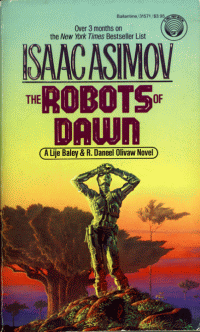
At this point if you have not read both The Caves of Steel and The Naked Sun, this review will contain plot spoilers for those novels. I highly suggest reading both of those before even reading this review.
The Robots of Dawn takes place 2 years after the events in The Naked Sun. At the conclusion of The Naked Sun Elijah Baley is resolved to push Earth toward space expansion. He must face the open spaces of Earth and encourage others so they can prepare for colonization. His goal is to approach Aurora, the most powerful Spacer planet to petition for approval for expansion. The Outer Worlds have cut off Earth from immigrating to them, so the only solution is to expand to new worlds. This essentially was the goal Dr. Han Falstofe spoke of in The Caves of Steel. The long-lived Spacers haven’t colonized a planet in over two centuries, and according to Falstofe the future of colonization must lie with Earthers.
The book opens with Elijah Baley sweating under a tree. He is Outside (with a capital O) conducting an open air acclimation exercise along with his son and group of other prospective colonists. He gets his opportunity via a robot messenger. He has been called to see the Commissioner regarding Aurora. Dr. Han Falstofe has recently become one of the most influential leaders in Aurora, and would most likely support expansion from Earth. His politial career hangs in the balance, because he is accused of roboticide. Baley is assigned to investigate the death of R. Jander Parnel, a humaniform robot of the same model as Daneel. The future of Earth’s expansion seems to lie on Elijah Baley’s shoulders.
Overall, this book has quite a bit more character development than previous novels and is almost twice as long as The Naked Sun. One of my favorite additions is R. Giskard Reventlov, one of Dr. Han Falstofe’s most trusted robots. We learn much more about Falstofe’s history and his relationship with Gladia which he took under his wing. Baley’s character grows as he gets deeper into the investigation as he is immersed in culture on Aurora that is as different from Earth as it is from Solaria. One of my favorite themes, the impact of robots on humans, is expanded on here. There are many other philosophical themes that keep you interested until the end. Note: Many of the scenes involved in this book are more for an adult audience, so I’d rate it PG-13 or so.

Nice Review man…..i’m gonna read the robot novels ALL OVER AGAIN!!!!!A
Thanks, be sure to come back and let me know your thoughts on the books as you read them. What order will you be reading them in? Be sure to check out “Johnny Pez’s Insanely Complete Fiction List” under the links on the left sidebar. http://www.scifi-review.net/insane_list.php