Remember at the end of The Empire Strikes Back where Luke gets his hand chopped off by Vader? During one of the closing scenes, a robot doctor finishes up installing a replacement hand for Luke.
Kevin Warwick did something similar as an experiment, but without the whole getting his hand chopped off step. Instead he put an electrode in his hand that could transmit commands to a robotic hand through radio waves. This was done back in 2002, and somehow I never heard of it. I’m sure Ray Kurzweil would be proud. Check out the video below for more information about how he did this, and some other advances like using rat brain cells to power robots. If you are at all interested in robotics, cyborgs, or AI, you’ll be in for a treat.
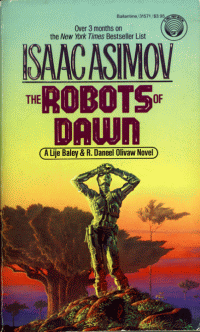
Nobody is sure when exactly Isaac Asimov was born due to poor record keeping. January 2nd, 1920 was the day Isaac Asimov decided to celebrate his birthday. Along with creating the Three Laws of Robotics, Asimov also unintentionally coined the term robotics. It was first used in print when his short story “Liar!” was published in 1941. He was constantly writing in just about every area of literature. I have primarily read his Science Fiction, but he has done textbooks, humor, mystery, non-fiction, and more.
My first exposure to Asimov’s writing was when my father gave me an old worn out copy of I, Robot. I tucked the book away for a few years and eventually got around to reading it. I was so enthralled with the robots that I eventually read every robot book by him and other authors. This naturally led me to read the Foundation series which I also enjoyed, but I’ve always preferred the robot series. The Robot and Foundation books make up the biggest reading project I have ever completed. Aside from those, I’ve read a bit of his autobiography and plan on sampling some of his other writing in the near future.
By the time I discovered Asimov, he had already died. I wonder how much more he could have written had he not contracted HIV from a blood transfusion he received during heart surgery. He died of myocardial and renal complications on April 6, 1992, but the true cause of his death wasn’t publicized due to the stigma of HIV/AIDS at the time. His work has greatly influenced my love of Science Fiction, and for that I am thankful.
For more information on the life of Isaac Asimov, please visit the official Wikipedia post
How would you like to control your own personal robot to do your bidding? The new movie Surrogates, starring Bruce Willis, takes this concept to extremes. In the movie, humans link their minds to a robot and control them directly. This is a bit different than being converted to a cyborg like Ray Kurzweil predicts.
As CNN reports:
“Surrogates” director Jonathan Mostow, whose film credits include 2003’s “Terminator 3: Rise of the Machines,” said he was drawn to the concept of surrogate robots as an extension of current technology. And, he said, as he met with scientists, he became convinced that something approaching the concept could one day be a reality.
It seems like the concept of “old fashioned” humanoid robots is finally becoming outdated. I wonder how Isaac Asimov would feel? It is one thing to boss around a robot using the Second Law of Robotics, but actually mind-melding with one, or becoming one is completely different. The main dilemma in Surrogates is that someone found a way to fry someone’s brain before they were able to jack out of the robot they were controlling. This concept is very old, dating back to the old Virtual Reality plots. I was very interested in the movie when I first saw the trailer, but after reading some lackluster reviews, I think I might just wait for DVD.
The critics could be wrong though. Do any of you think I should give it a chance?
Check out the full article via CNN for more information. I found it to be an interesting read.
It’s been quite a while since I’ve read Dune. I found my way to this interesting conceptualization, Sietch Nevada, through my regular StumbleUpon clicking. For those not familiar with Dune by Frank Herbert, please check it out! It is an excellent novel, as described in my review. I find it interesting how many ideas are drawn from Sci-Fi. Everyday technology like cell phones, video conferencing, and robots (well maybe not everyday yet), were hinted to by authors long before they were developed. I find the Sietch concept intriguing because I lived in Phoenix, AZ for many years. A few years after I left, I started hearing about how Lake Powell, fed by the Colorado River, might dry up soon. I thought that it meant there would be no more water, but experts are referring to “dry” as unable to generate hydroelectric power. So, not only will water levels be low, but there could be power shortages as well!
Ever since I first read I, Robot by Isaac Asimov I have been interested in robotics and AI. Back in 1996 or so I had no idea that simulation of a brain might be possible in my lifetime. John Lehrer with Seed Magazine has written a very interesting article, “Out of the Blue“, which covers the Blue Brain project led by Henry Markram. One of the biggest challenges was determining how exactly a neuron is supposed to behave. Without that information, it would be impossible to simulate it. One of the freaky things about this project is that they have a robot conducting experiments and recording data 24/7. This robot is more efficient than 10 experienced lab technicians combined. I would assume that this robot only has enough programming to complete these experiments, but what if robots become sentient? What would keep them from creating other more capable robots? The current project aims to first simulate the brain of a 2 week old rat, which would then be transferred to a robot body to see how it develops.
With the current progression of technology, Markram suggests, “In ten years, this computer will be talking to us.” That seem a bit crazy, but who would have thought 10 years ago that there would technology capable of simulating 10,000 neurons and 30 million synaptic connections? That currently only represents a small slice of a 2 week old rat brain, but given how fast computing power is growing, I can’t see why Markram’s prediction would be impossible. If not 10 years from now, why not 20, or 30? I think that it is just a matter of time. I highly recommend reading the full article, especially if you have any interest in robotics or AI.
I’ve been a bad reviewer lately. I usually try to write my reviews right after viewing or reading but I haven’t had as much time to write them lately. I’ve been playing World in Conflict quite a bit lately, which competes with my reviews here. I should actually do a review for that sometime, since I spend so much time playing it. It takes place in an alternate reality where the Soviets invade the US in 1990. For more information in the meantime just click the link above.
So, here are the things I have watched so far, but have yet to review:
- Blade Runner – The Final Cut
: (I’ve watched the movie, which was awesome, but I still have to work through the rest of the special features on the last disc)
- I am Legend (2007) – I’ve actually watched this twice, once with my Father while on vacation, and again with my wife
- Battlestar Galactica: Razor – Unrated Extended Edition
I’m also in the process of reading two books: Children of Dune by Frank Herbert, and The Age of Spiritual machines by Ray Kurzweil
. The latter is not really science fiction, but I’m about half way through it and many of the ideas probably seemed like fiction back when it was published in 1999. Many of the predictions Kurzweil makes in the first half are fairly accurate, so I’m interested to see what he will say in the second half.
My next major milestone will be to read Chaos Theory, Asimov’s Foundations and Robots, and Herbert’s Dune: The Fractal Aesthetic of Epic Science Fiction.
That should keep me busy for a little while.
R. Daneel Olivaw is my favorite character from the Robot and Foundation Universe created by Isaac Asimov. The R stands for “Robot,” but he became much more than that over the course of the Robot and Foundation series. Hari Seldon from the Foundation Novels ranks a close second, but my heart goes to Daneel and the Three Laws of Robotics. I’m amazed at how many twists can be made based on three relatively simple rules of behavior. Daneel starts as one of the first humaniform robots, but eventually evolves into much more complex being.
The following discussion is filled with spoilers for the entire Robot and Foundation series, so read it with that in mind. Continue reading »
The brilliant minds over at The Onion have answered this question. I just ran across this video and it gave me a good chuckle. I hope you like it also.
In The Know: Are We Giving The Robots That Run Our Society Too Much Power?

Today marks the release of Blade Runner – The Final Cut, directed by Ridley Scott. Blade Runner is loosely based on the novel “Do Androids Dream of Electric Sheep?” by Phillip K. Dick. Blade Runner has been one of my favorite Sci-Fi movies since I saw the original Director’s Cut at a friend’s house while in high school. He and his brother insisted that it was the only version worth watching. Consequently, I have never seen the original theatrical release with the happy ending and Deckard’s voiceover narration. From what I’ve read, the studio executives were the main influence for those changes.
To commemorate the release of The Final Cut, which I hope to review sometime soon, I will share my thoughts on the Director’s Cut DVD released back in 1997. I had only seen Blade Runner on VHS back in 1995, and was anxious to see it in the higher resolution and sound quality that DVD had to offer. The video is of poor resolution and visibly shakes slightly, which is annoying. The soundtrack is in just 2 channels, failing to utilize the 5.1 Dolby Digital that DVD offered. I’ve watched it several times over on DVD, and again this weekend, and every time the poor transfer sticks out like a sore thumb. This was one of the first DVD releases, so was barebones with no extra features other than a chapter selection. Continue reading »
I am always amazed that the developments in robotics that are happening in my lifetime. I wish that Isaac Asimov had lived just a bit longer so he could see what the industry is producing today. Sarcos has made the prototype, which is under development in Japan. This robot can recover from pushes intended to topple it over. I’m sure a lot of you have seen the video of the ASIMO robot falling down some simple steps. This new robot with flexible joints and advanced balancing system appears to be the next generation of humanoid robots. For more information, including a video demonstration, check out the full article at NewScientistTech. Found via SlashDot


Recent Comments