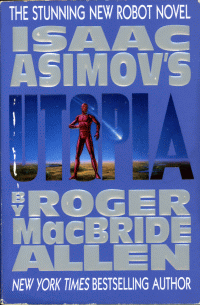
The Science Fiction Review Books,Robot and Foundation,Caliban Trilogy Isaac Asimov’s Utopia by Roger MacBride Allen

Isaac Asimov’s Utopia by Roger MacBride Allen

Utopia book cover

About five years has passed since the New Law robots were put to work at Purgatory to assist with the terraforming effort for Inferno. Alvar Kresh won the election for governor and ended up choosing a dual terraforming system combining a positronics with a super computer. In an unexpected turn, Kresh ended up marrying Fredda Leving. Initially I thought that they made a rather odd couple, but I think Allen did a good job of handling their relationship throughout this book. The main plot Utopia revolves around a plan by a scientist to harness a comet and blow it apart to dig a huge channel from the southern ocean to the frozen northern ice cap which would otherwise be impossible by conventional means.

The argument for this drastic measure is that the existing terraforming effort will fail much sooner than expected. In just a few years the surface of the planet might not be habitable. That probably wouldn’t be a problem for Settlers since they prefer their underground buildings, but for Spacers it would pose a serious problem. The comet plan might sound plausible given the combined efforts of the Spacers and Settlers, but there are many that don’t want this to happen. Many fear that something will go wrong and the planet will be destroyed. Also, how will robots allow such a task to take place given the nature of the Three Laws? Will robots allow a comet to hit the planet? Allen answers this in unexpected, yet plausible ways which I’ll leave you to uncover.

One thing that I didn’t notice until this book in the series was that Allen had not really addressed the fundamental differences between Spacers and Settlers. In chapter 4 he explains that Spacers age much more slowly than Settlers. There were no precautions such as nose plugs or aversions to touching for fear of infection that you’d normally expect a Spacer to exhibit toward others. Possibly by this point they treat Settlers differently than Earthmen or have better less obvious protections which Allen doesn’t explain.

I think the reason I liked this book much better than the last was that there were many small mysteries. There was the main question of whether or not the comet plan would work, but the ancillary plots which came along were intertwined rather nicely. The pieces start to fall together bit by bit rather than the abrupt fashion from the last book. There was a definite “ending” to the series, although a bit cheesy, which tied everything back together.
Leave a Reply

Your email address will not be published. Required fields are marked *

Please prove you are a human * Time limit is exhausted. Please reload the CAPTCHA.

This site uses Akismet to reduce spam. Learn how your comment data is processed.

Related Post

Yes, I am still aliveYes, I am still alive

Where have I been lately? A number of factors have resulted in me not posting since December. One of which was that over the past few months I’ve been chipping away at The Collected Stories of Arthur C. Clarke. At just shy of 1,000 pages, it has been my lunch time reading for a while now. There are a couple short stories that I plan on reviewing, as soon as I can remember to bring the book home from work. I’ve also been filling most of my free time, 177 hours now, with playing Battlefield 3 (my stats).

I’ve watched a few movies, but I didn’t get around to reviewing those. One was Gamer, which I didn’t expect much from. The other was Battle: Los Angeles, a cookie cutter “aliens attack, let’s fight back” movie. I didn’t really “watch” these as much as listened to them as I cleaned out my office. After going through my recent posts, I noticed that I never reviewed 28 Weeks Later. This was actually one of the sequels I’ve seen that I liked more than the original. I might have to re-watch, then write up a review. I watched a decent movie last night though, The Adjustment Bureau, which I plan on reviewing in the next few days, if not tonight. My goal for myself is to have it done before the end of the month. Thank goodness for leap years!

OK, enough excuses. Thanks to all of you that still have me in your newsreader. I’ll try to be better about posting updates in the future.

Sietch Nevada concept straight from Frank Herbert’s DuneSietch Nevada concept straight from Frank Herbert’s Dune

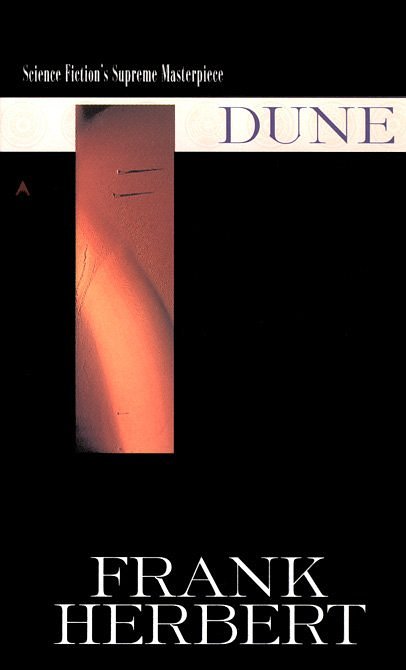
Dune Book Cover

It’s been quite a while since I’ve read Dune. I found my way to this interesting conceptualization, Sietch Nevada, through my regular StumbleUpon clicking. For those not familiar with Dune by Frank Herbert, please check it out! It is an excellent novel, as described in my review. I find it interesting how many ideas are drawn from Sci-Fi. Everyday technology like cell phones, video conferencing, and robots (well maybe not everyday yet), were hinted to by authors long before they were developed. I find the Sietch concept intriguing because I lived in Phoenix, AZ for many years. A few years after I left, I started hearing about how Lake Powell, fed by the Colorado River, might dry up soon. I thought that it meant there would be no more water, but experts are referring to “dry” as unable to generate hydroelectric power. So, not only will water levels be low, but there could be power shortages as well!

Foundation and Chaos by Greg BearFoundation and Chaos by Greg Bear

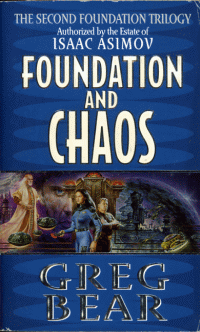
Foundation and Chaos book cover

For those that read my previous review on Foundation’s Fear, you will be pleased to find that Greg Bear manages to save this series with his masterful work in Foundation and Chaos. If there were ever two books on the same subject that could be so different as to compare night and day, the first two parts of the Second Foundation Trilogy are it. While the first volume kept putting me to sleep with rambling on about simulated minds and aliens, Foundation and Chaos goes back to the roots more in line with the universe Asimov made me fall in love with. (more…)