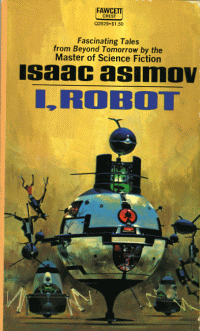
I, Robot by Isaac Asimov

I-Robot Book Cover

    The Three Laws of Robotics

  1. A robot may not injure a human being, or, through inaction, allow a human being to come to harm.
  2. A robot must obey the orders given it by human beings except where such orders would conflict with the First Law.
  3. A robot must protect its own existence as long as such protection does not conflict with the First or Second Law.

First things first, the Hollywood movie I, Robot (also reviewed) with Will Smith has only has a few things in common with this book of short stories. Keep in mind that the NAME was licensed to the movie studio after the script was already written. Scenes were adjusted to include the Three Laws, Susan Calvin, and Alfred Lanning. That is about where the similarities between the book and the movie end. There might be a few concepts stripped from some of the stories, but by no means is the film “based” on the book. To give the movie makers credit, they only say “inspired” by in the opening.

I, Robot is a collection of short stories by Isaac Asimov. Keep in mind these stories were mainly written in the 1940s then published together in 1950. These stories describe the basics of the Three Laws of Robotics and what can go wrong with them. Asimov uses the Three Laws as a literary device to create puzzling situations. Several of these stories involve Susan Calvin, the top robo-psychologist for the only robot manufacturing company, US Robots and Mechanical Men, Inc. If anyone is interested in reading the Robot Novel series, this book kind of acts as a nice introduction to the basic concepts. As a matter of fact, anyone with any interest in Sci-Fi should read this book. I consider it required reading.
Leave a Reply

Your email address will not be published. Required fields are marked *

Please prove you are a human * Time limit is exhausted. Please reload the CAPTCHA.

This site uses Akismet to reduce spam. Learn how your comment data is processed.

Related Post

Isaac Asimov’s Robots and Aliens Book 5: Maverick by Bruce BethkeIsaac Asimov’s Robots and Aliens Book 5: Maverick by Bruce Bethke

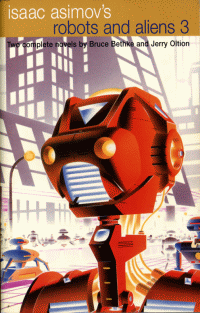
Robots and Aliens Volume 3 book cover

This review will most likely contain spoilers for any previous books in the series, read at your own risk.

Toward the end of Alliance, Derek agrees to transport the three shape changing robots to the cannoid inhabited planet that Adam originally emerged from. The title of the book refers to a subplot about a loner named Maverick, which was expelled from a main pack some time ago. His goal is to join PackHome. I really didn’t identify with this character at all. In the meantime the Robots on the planet agree to treat the cannoid inhabitants as humans in order to give themselves a purpose.

Overall this book has a little bit of action, but seems to me to be nothing more than a stepping stone before the final book. I didn’t really enjoy it that much because nothing seemed to really happen. I’m looking forward to the final book to see how all of this will finally be tied together.

Foundation’s Triumph by David BrinFoundation’s Triumph by David Brin

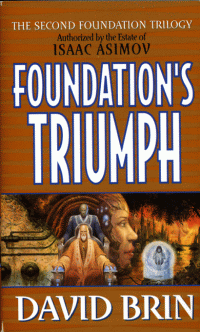
Foundation's Triumph book cover

David Brin does a good job of unifying the Robot and Foundation novels by explaining many of the contradictions which come up if we assume every book written so far is to be viewed as in the same universe. One of the nagging questions which bothered me while reading the series is, “How did 25 million worlds get settled in just 20,000 or so years?” Brin explains this and many other things throughout the novel. At some points it seemed that he was reaching very hard to explain every single little detail linking the other novels together. Overall the book was enjoyable, but I think that the last one was significantly better. (more…)

Donnerjack by Roger Zelazny and Jane LindskoldDonnerjack by Roger Zelazny and Jane Lindskold

Donnerjack Book Cover

One thing I like to do before I review a book is to look up some Wiki pages and other reviews to get a feel for how others reacted to the book. First of all, the Wikipedia entry for this book was no help at all, so much so that I’m considering updating it myself. I’m glad I took some notes while I was reading. I ran across some very harsh reviews on Amazon that had I read beforehand, I might not have picked up this book. Quite a few of the die-hard fans said to read just the first third of the book and stop. After that point, many of the reviewers pointed out that it is fairly obvious that Lindskold deviated from Zelazny’s quick and witty formula.

I, however, loved Donnerjack. It is probably one of my favorite reads in the past few years. About seven years or so ago I enjoyed reading The Great Book of Amber by Zelazny. It was also one of my first exposures to fantasy along with the Wheel of Time by Robert Jordan. Later on I went on to read Lord of Light, also by Zelazny, which I also loved. I’ve also read This Immortal and finally Lord Demon, which is the other book of Zelany’s that Lindskold helped finish. Lord Demon was good, so I didn’t think twice before grabbing Donnerjack. I’ve also not read any Zelazny in the past 3-4 years, so I can’t say I was as aware of the change in writing style as others were. With that said, there was definitely a noticeable difference between Part I and Part II. Thinking back, I would almost say that they could have been split into two different books. (more…)